Second Place | Dozed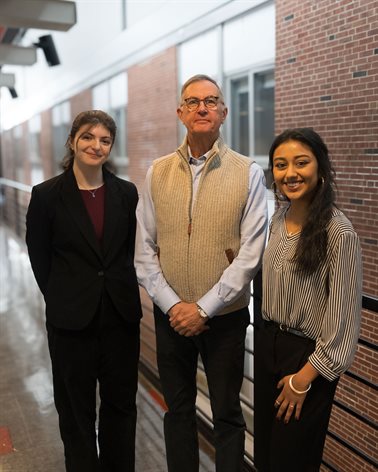
Ralou Benos & Aashi Shah
Dozed is a holistic smart sleep system designed to combat sleep grogginess by waking users at the optimal point in their sleep cycle. The system pairs a wearable Slumber Sock, which monitors sleep patterns, with a bedside Beacon that uses gentle audio and visual cues to help users wake more naturally.
What distinguishes Dozed is its integrated, end-to-end approach to sleep technology—combining multiple sleep tools into a single, affordable system.
“Because Systems Engineering integrates both technical and business skills, it greatly improved our delivery and presentation of the product,” Aashi Shah explained.
Through the Challenge, the team developed both technical and business expertise, from app development and hardware integration to cost modeling and return analysis. Looking ahead, they plan to gather more sleep-cycle data and refine the Slumber Sock for improved comfort and usability.

Third Place | GlassMate
Shuban Narayanan, Sangwoo Park, Joshua Studee & Sid Vadyalam
GlassMate is a set of clip-on modules that transform any pair of glasses into smart glasses, designed to help users better understand and interact with their surroundings. The system is especially intended to support individuals with cognitive or visual impairments, including those living with Alzheimer’s disease or dementia.
GlassMate’s innovation lies in its flexibility and accessibility. Unlike many existing smart-glasses solutions, the clip-on modules can attach to prescription glasses, sunglasses, and other eyewear, while remaining significantly more affordable.
The team gained hands-on experience across multiple disciplines, including 3D printing flexible components, computer vision development using OpenCV, Raspberry Pi integration, competitive analysis and value-driven product positioning. Their ISE coursework, particularly in engineering economics and computer-aided design, played a critical role in shaping both the product’s technical design and pricing strategy.
Next, the team plans to improve the prototype by expanding facial and object recognition capabilities and developing additional attachment modules, such as speaker-based assistive features. They also aim to refine the physical design using more durable, precise materials. Their advice to future participants: start early to allow time for troubleshooting, iteration and optimization.
The ISE department also extends its sincere thanks to the 2025 Mottier Innovation Challenge judges for their time, expertise and thoughtful feedback: Jason Lee (BS GE ’95), Matthew Luallen (BS IE ’98), John Holz (BS GE ’76; MS GE ’81), Bradley Mottier (BS GE ’79; MS GE ’81) and Professor Tom Titone.
Congratulations to all participating teams for their hard work and innovation!